
Reversing the Tide: How Wisconsin’s Private Colleges are the Key to Solving the “Brain Drain”
 A recent report from the Wisconsin Policy Forum (WPF) has cast a spotlight on a persistent challenge facing our state: the “brain drain.” According to the WPF analysis of Joint Economic Committee (JEC) data of the U.S. Congress, Wisconsin has historically struggled with one of the nation’s largest gaps between the number of highly educated individuals leaving the state versus those moving in. In fact, for decades, Wisconsin has ranked among the bottom five states for this critical metric.
For Wisconsin’s private, nonprofit colleges and universities, these findings are not just a datapoint; they are a call to action. As we look toward a future where Wisconsin’s workforce is projected to shrink by 130,000 by 2030, our institutions stand as ready partners to help reverse this pattern. We are not just educators; we are engines of talent retention and economic activity.
Understanding the Challenge
The Joint Economic study, which focused on the 31-to-40 age cohort, found that over 20 percent of those born in Wisconsin who moved away were “highly educated” (holding a bachelor’s degree or higher), while less than 10 percent of those moving into the state met that criteria.
This 10.7 percentage point gap is particularly stark when compared to our neighbors. Illinois and Minnesota both saw “brain gains,” successfully attracting more highly educated individuals than they lost. The proximity of dynamic metro areas like Chicago and Minneapolis acts as a powerful magnet, drawing our talent across the border.
The Private College Advantage
Wisconsin’s private, nonprofit colleges and universities are uniquely positioned to address this imbalance given they are deeply embedded in the local fabric of Wisconsin and their communities. We don’t just graduate students; we integrate them into the Wisconsin economy. Over 50 percent of students enrolled in private, nonprofit institutions come from outside of the state. While a significant number remains in Wisconsin after graduation, Wisconsin could provide additional policy incentives to encourage more graduates to stay and work in Wisconsin.
Additionally, our institutions emphasize community engagement and local internships. By connecting students with Wisconsin-based businesses early in their academic careers, WAICU members build professional and social networks that make staying in Wisconsin a natural choice.
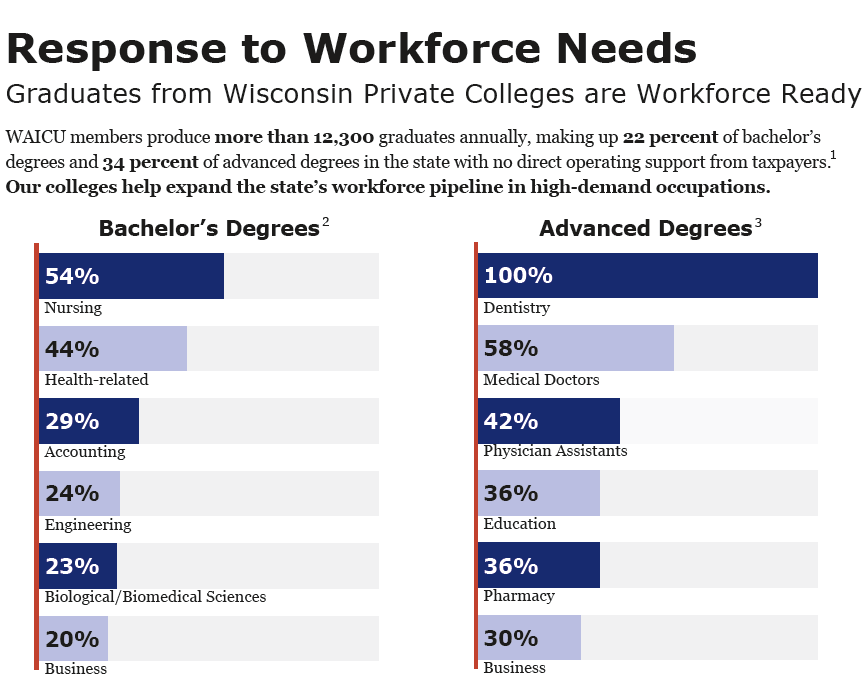
Our private institutions are nimble, constantly updating curricula to meet the specific needs of Wisconsin’s emerging industries, from bio-health to advanced manufacturing, ensuring our graduates are the most competitive candidates for high-paying, local roles.
A Collaborative Path Forward
Solving the brain drain requires more than just academic excellence; it requires a unified strategy between higher education, business leaders, and elected officials.
To our business leaders: We invite you to deepen your partnerships with our campuses. By offering robust internship programs and participating in career mentorship, you provide the “proof of concept” that a high-quality, high-paying career is available right here in Wisconsin.
To our elected officials: We need policy environments that incentivize talent retention and support the institutions that produce that talent. Last session, legislation was introduced to create an economic development fund that would support innovative opportunities at WAICU member institutions. This grant would create one-time state investments in programs and initiatives at Wisconsin’s private colleges and universities that could yield a significant return on investment for Wisconsin.
Beyond the Numbers
The “brain drain” is not an inevitability and can be reversed. Wisconsin’s private, nonprofit colleges and universities are committed to being the catalyst for this change. By fostering innovation, reducing financial barriers, and creating direct pipelines to local employment, we are ensuring that Wisconsin’s educated workforce stays here, builds families here, and leads our state into a prosperous future.
Together, we can turn the “brain drain” into a “brain gain,” ensuring Wisconsin remains a premier destination for talent, innovation, and growth.